A. F. Grappin
  • Home
  • About Me / Patreon
  • Library
  • Writing Samples
  • The Chain Nerd

What activities help you overcome writer’s block?

2/9/2026

0 Comments

 
​I’ve kind of talked about this in the past, but I think it’s largely been in other media, so let’s go ahead and discuss it here.

For me, there are two forms of writer’s block: the plot-block, and functional.

The plot-block has been the hardest for me to find ways to overcome. Sadly, it’s also the form I have the most history with. I’ve spoken in the past about the differences in my productivity before and after 2009, when I finally started outlining things. In short, outlining has made it a lot more likely that I’ll finish a project as opposed to starting it and then just… not finishing. Outlining lets me find all the major and medium snags in story prep and planning. I don’t get into serious small details, but anything that might derail the major plot or some medium subplots and all, I can confront in this planning stage rather than writing myself into a corner.

But… just because I’m outlining doesn’t mean these snags don’t crop up. Of course they do. Discovering them in the outlining phase rather than while actively engaged in writing really helps make problems like these more manageable. I’m not losing writing time by struggling to think where to go next. I don’t fall out of the zone or vibe or rhythm of writing because I lack signposts. The outlining gives me signposts, a map to follow. 

So what do I do when developing that map and coming across a plot snag?

My favorite technique is one I read about some years ago randomly online. I wish I could reference the original article, but the fact is I haven’t been able to find it. In short, it was a (current or former) Pixar writer who gave me this tool:

When you can’t figure out what happens, figure out what doesn’t happen instead.

Here’s how it works for me. I get pencil and paper or open another blank text document. The format doesn’t matter, but for me, I need there to be a visual representation to help mark the productivity. If you don’t need it, great. But for me, it’s necessary. This new document is going to be a mental declutter list. 

When I say figure out what doesn’t happen, I mean anything and everything. Say the plot you’re stuck in is about how a trapped character escapes their captivity. But now you’re stuck, almost paralyzed trying to figure out how to dig yourself and your character out of the problem you’ve put them in. 

I just start listing things. They don’t even have to make sense. But list anything that comes to mind and discard it as “not gonna happen.” Aliens don’t come and break him out. He doesn’t find a magical sword to cut his bonds. His god doesn’t appear to him. The magic gem he has doesn’t summon a genie…

Wait… he had a magic gem?! That’s right, maybe I can find a way to use that! Maybe it DOES summon a genie!

I’ve had the answer come that quickly before. I’ve had times where I’m writing random shit down for the better part of an hour, and then something just clicks. Thing is, I have yet to have this not work when I’m in a bind. 

What’s happening (at least for me) is what I’ve said before: decluttering. By actually writing down what doesn’t happen, I’m thinking of ideas but actually removing them from my head through the act of writing/typing them out. This way, those random fragments of ideas that don’t work aren’t just bouncing around in my brain anymore. The cleared space makes room for new ideas to form. But by doing random not-important creativity, I’m activating that portion of the brain, putting it to work to come up with bad ideas. And they inevitably make way for the right ideas to start happening. Sometimes, I’ll remember a detail from earlier planning that just seems to fit (like the gem/genie idea I made up) or I’ll just come up with something else entirely that can solve the problem… but then I realize that just came out of nowhere. But this ties back into outlining. Now that I know I’ll need that solution, I can much more easily backtrack in the outline and seed this new resolution, rather than going back and rewriting a first draft. I haven’t even written any of that yet. So easy to note [DETAILS NEEDED ABOUT THIS ITEM] or whatever the result is.

Give it a try next time you’re stuck or just want to find something unusual to get out of a situation. It helps come up with different options, even when you’re not stuck or blocked.

Functional block is the more frustrating one. And I’m really using that as a sort of blanket term to cover all the sort of normal perceptions of writer’s block, anything that keeps you in a state of just not being able to get words onto the page. I’ll also include burnout in this category, but I’ll talk about that kind of separately.

Functional writer’s block in general I can usually combat by just working on a different project than whichever one I’m stuck on. I bust out a writing exercise, a short story, or something else that activates the same portion of my brain, but maybe uses a different track of it. Like… think of the brain as one of those soda fountains with different flavors that all use the same spigot. Yeah, I need Mountain Dew, but that’s out of syrup. Doesn’t mean I can’t get the strawberry Sprite to pour! It can be stream of consciousness, a writing prompt, an exercise, another project, anything! Heck, sometimes I even resort to a different craft: making something with my hands, dancing in my kitchen, whatever.

Usually, that’s enough for me. Spend enough time on other things, but still creatively, and the urge, drive, or inspiration to get back to that “main” project usually comes back along. If not… well, sometimes you do need to abandon projects. At least I’ve still been productive on other things in the meantime. 

If that doesn’t work, then we go to our last tool (that I have currently). Sadly, this is also the only tool I’ve found that will always defeat burnout in the end. 

That activity is… give it time. 

As much as I spend my life waiting, sometimes that’s literally all there is to do when something is causing you to struggle. I’ve talked before about my own burnout. Still, here’s the story and how time was all I could make work for me.

I spent three or four years mired in a self-imposed schedule to get the entire Deadly Studies series of novellas off the ground. Originally, it was planned to be 7 novellas, but it turned into 10 due to plot expansions to tie it in with its parent series, The Statford Chronicle. I pushed myself hard for those few years, planning the series and then writing, editing, and releasing each novella rapidly. I was basically releasing one every 3-4 months for a few years until they were finished.

The last one came out in September 2019. The final volume, containing novellas 6-10, came out in January 2020.

And I couldn’t write shit after that. I let myself take a break because I was exhausted, but… once COVID-19 hit and I suddenly had a lot more time to do things due to quarantine, I couldn’t make writing happen again. I tried editing some short stories to fit them together into a more cohesive collection so I could release an anthology, and it seemed to be going well. Until I realized I needed to write a few more stories to tie everything together, and the idea just kind of fizzled after a few paragraphs. 

I gave myself more time. By mid 2021 I was working on editing/updating a sci-fi trilogy I already had written. I even got through the first book (this was my fourth draft that needed serious restructure) and it was fine. But book 2, ready for its third draft and restructure, never quite got off the ground. And I haven’t even looked at book 3, which is still in its first draft state. By 2022, I’d sort of let that peter out. I hadn’t written anything new in 2 years and… at this point, I’d already gone through a lot of existential crisis thoughts about maybe I’d completely burned myself out. Maybe The Deadly Studies was it for me, and I’d ruined my writing brain. It wouldn’t be the first time I’d overworked myself into destruction. I don’t compose or play music anymore because I burned myself outt oo hard in college. 

By the end of 2022, I had finally made peace with the possibility of never writing again. 2023 came and went, and 2024 started.

A few months into 2024, an idea came to me out of nowhere, and I started writing an outline. It was easy, and the ideas were good. Better than anything I remembered doing before the burnout. I found myself in tears more than once, relieved that after basically 5 years of not really writing (at best, proofing, revising), I was suddenly creating from nothing again.

Enter 2025 and… well, this website blog and my Patreon stand as proof that I’m writing again. I’m still writing. I tried forcing my way through the burnout, but it was not rewarding. 

I might never have come back to writing. Like I said, I made peace with the possibility of never writing again, but it was a good three years before I even got to that point. Three years of mourning what I’d been able to do so recently, not knowing if I’d be able to repeat what I’ve done before. And then at least another year of it basically falling off my radar. Writing became something I’d done and that I hoped to do again one day, but… I no longer felt like I was less for not being able to do it in the moment. It was a struggle, but not one I couldn’t live with.

It was a magnificent day when the block finally eroded and let my brainriver flow again.

But in short, I have not found any way to force-overcome writer’s block. In any form. You can work around it sometimes, but sometimes the only cure is to wait it out. Patience is a virtue, and sometimes it’s the most powerful tool we have. 
0 Comments

Who is your favorite author and how have they inspired you?

1/12/2026

0 Comments

 
I’ve talked about some of my favorite books before and what they taught me. At this point, I don’t know that I can honestly say I have a favorite author. I’ve read too widely at this point to be able to single out an individual and say they’re my favorite. I’m more likely to focus on one technique or skill and say they do this thing well.

So I suppose that’s what I’ll focus on here. A few authors I like and what they do well. Because all these things they do well are what inspire me to upgrade my own writing skills. So here are a few authors I admire and what I admire them for. Keep in mind these opinions are my own and I neither can nor will excuse any bullshit they pull or believe on a personal level. This is just about the writing.

Robin Hobb - Endings. Holy HELL can Hobb write endings that are satisfying. And I mean that for books and for whole series. I’ve read the Soldier Son trilogy multiple times, and each book is so well contained but the whole series is wrapped up well, too. And then there’s the expansive multiseries series The Realm of the Elderlings. Not only are each book and each series wrapped well, but the final ending to the whole epic is just… epic. I cried so hard, so emotionally sated that I almost couldn’t handle it. Hobb makes it bittersweet but easy to accept the goodbyes readers say to characters, especially ones we’ve traveled with across years and many many books. I’d kill to be able to write an ending one-tenth as satisfying.
​
That said, the beginnings aren’t as gripping. Many of them start very slow and take some settling into. But once in, if you’re not hooked, then please don’t force your way through. Every book isn’t for every reader. That’s why we have variety. But if you want a good ending, go for a Hobb book.

Matt Dinniman - Okay, to be fair, I’ve only ready his Dungeon Crawler Carl series so far, but I do have others in mind to read eventually. But from DCC, I can say this man is great at having things happening behind the scenes and revealing them in fantastic ways. He very much keeps in mind that “onscreen” characters aren’t the only ones with agency, and he makes forgetting it your problem. Anything that seems to come out of nowhere has inciting seeds ages ago that you just dismissed because it didn’t directly affect what you were seeing as a reader, especially if it’s through the eyes of your POV character. Dinniman is great at keeping you informed of the small details of things as you need to know them.

I guess I’m also going to mention a small personal gripe I have with each author, so here we go. And oh, is this a total nitpick on my part. So trivial it annoys me that I’m annoyed by it. Dinniman as a couple technical word choices that I can’t help but notice and get a tiny spike of annoyance at the repeated use of the word. The main one is the word “upon.” He uses it instead of the more simple “on” a lot more than anyone else I know. And it seems… so out of character for the narrator, Carl, to use that so much. Similarly, he uses “as” phrases really often. I haven’t gone and one any sort of analysis of how often Dinniman does both these things, but it’s enough that I’ve noticed them both. Might not have noticed if it weren’t for listening to the audiobooks, but yeah, I’ve noticed. Like I said, tiny gripes.

Stephen King - I mean, obviously, he had to be in this list, right? Put simply, King has some great ideas and expands on them well. His beginnings are a lot more gripping than Hobbs’s, that’s for certain. His first line for The Gunslinger is often touted as like the quintessential, simple, gripping first line. That said, once King gets to a certain point, all sense of direction and conclusion just sort of… stop. Often, it’s not until the very last few pages of the book. I’ve read a number of King’s books and… I’m just never satisfied with the endings. So I guess for him, the gripe goes hand-in-hand with my praise. The man has fantastic ideas and really ramps up the conflict to dangerous levels. But it’s always felt to me like he can’t dig his way back out and just… ends things because he’s done trying. 
0 Comments

How do you come up with character names?

12/22/2025

0 Comments

 
There’s a whole lot of variety in my naming conventions, and sometimes, it varies depending on the story world I’m creating. I was working on a project (that I still may get back to someday, who knows) where the naming conventions for classes were very distinct. Nobility used nature names as part of their culture, mostly because they were certain in their dominance over the world. So you’d see names like Chrysanthe, Quartz, Cirrus, and Mesa. The commoners didn’t have that arrogance in their naming conventions, so I went with more “traditional” fantasy-style names. I did a lot of what I normally do for fantasy: modify normal names.
​
Modifying more common or normal names in fantasy is pretty standard for me, as I mentioned. It can be as simple as changing a vowel in an existing name: for the main villain in Criminal From Birth, I just changed the e in Brent to an i, and we get Brint. It can be changing a beginning or ending sound. Silas, with a different ending, becomes Silen. Kerry drops the y, becomes Kerr, becomes Cair to make the pronunciation a bit easier to get right when it’s only read. I’ve seen the name Monica in a book changed to Ronica, and it’s beautiful.

There’s also always the Pern version of blending names. It’s the same sort of blending that get used with shipping characters: you just mash the two names together. In Anne McCaffrey’s Pern books, children are most often named a mashup of their parents’ names. So F’lar and Lessa have a son named F’Lessan. Grab your parents’ names and rename yourself. I could be Kenry, Mareth, Manneth, Kary, or even Marketh.

Honestly, those are my favorite ways to name characters: the letter/sound substitutions or name mashups.

I’m also not above just putting my friends in books, either with their actual name or modifying them. And it doesn’t have to be just one change. Hell, go a few steps. Take a name, find a foreign language variation of it, and riff off that. Like, if you have a Henry, turn it to Enrique, and start messing with that. Spell it phonetically. Onrikay. Drop a sound. Rikay. Make it easier to read. Rickay. Change a vowel. Rackay. Suddenly, Henry is unrecognizable, but you have a usable name.

The point is, it’s no holds barred. I’ve seen unusual and unique names on people in real life. Celebrities names their kids all kinds of weird stuff. So find what you like and name your character that. Just… if you’re naming a real person, give that knowledge some consideration. They have to live with the name. It’s not like naming a pet.
0 Comments

Outlining Part 3 of 3

7/14/2025

0 Comments

 
This is the final part of my series of posts on my outline process. I call this Draft Point Five, because by the end, I end up with a thorough map to my story that can function as a sort of half-first draft. Less an outline, more of a sketch.

Anyway, so what we’ve ended up with after the last post is a whole lot of bullet points detailing the arcs of the main plot and probably a lot of characters. These bullet points have been organized into a comprehensive road map of the plot. Now we’re going to flesh things out a bit, make this road map a whole lot better. If our bullet points are the basic directions, we’re going to turn this into a full live-GPS tracking, to keep with that metaphor.

For an example of how this grows, we’ll use an old outline I was working on for a YA dystopia novel I’ll probably never finish. It’ll at least offer some insight into the process.

For this book, I ended up with this for my 7-point outline:

Hook- July 19. Mal's sister leaves him to go to the institution as she's supposed to. It's time for her to have her ruling emotion removed. Mal is now left completely alone, at age 14.

PT1- Mal's tracker goes off (on May 2), marking him as one day truant. But it shouldn't go off for another year. He runs. He's caught and is taken to the institution.

P1- Maybe having Anticipation gone isn't so bad... until he ends up in danger, perhaps in a physical aptitude exercise. Probably a situation involving Avis, where she gets the better of him. Badness in their rivalry. Really sucks to have it removed.
MP- You know what, if they're going to make me an adult a year early, then son of a gun, I'm going to be one. Accepts he can't stop what they did to him. No escaping, so can only move forward.
P2- Assignments disappear- all that's left are military and ONE other posting.

PT2- Learns he's had not one, but 2 emotions removed, Anticipation and Fear. Suspects Lachlan, lowest point. Mal depressed, nothing is going right. Badness with Avis, Baron, Joy, Lachlan, etc. Not having Fear ends up saving the day. DETAILS!

Res- Has to have something to do with anticipation. Maybe the last line of the novel is "In just a few more months, my year will be up and I'll get my first assignment. I'll be free of Dr. Wilkinson then. Four months. I can wait." Don't have him reach his next birthday yet. The paperwork/ policy change that makes him stay at the institution for another year needs to be the inciting incident of Book 2!

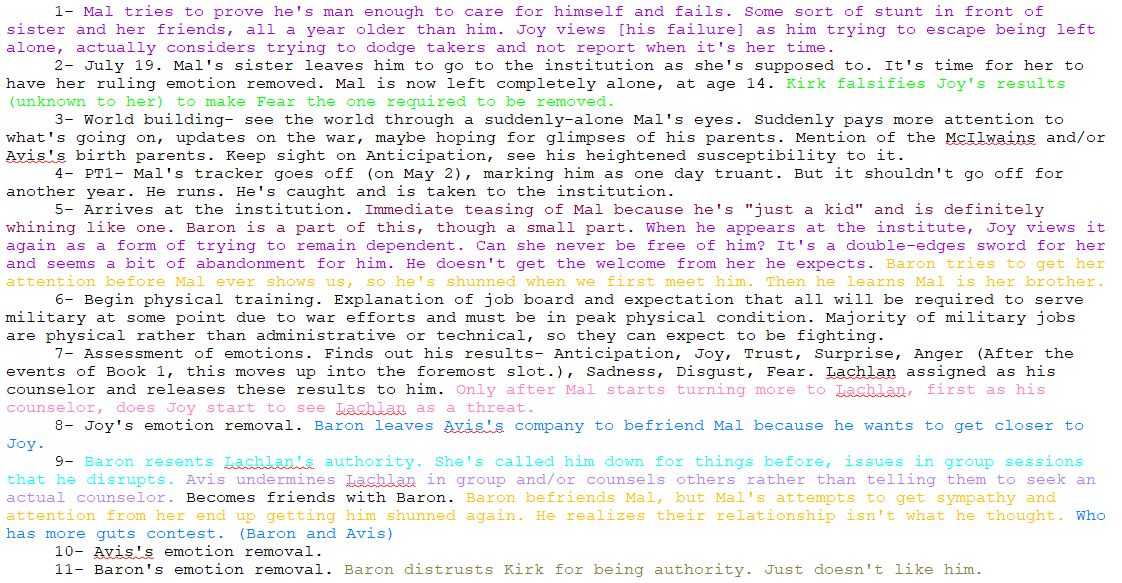
Yeah, this was planned to be the first book of a trilogy, and I was planning out the whole trilogy’s road map, hence the Book 2 reference. But anyway, this covered the basic plot. I did write out interpersonal conflicts between characters and expanded those a bit to make 3 to 7 conflict arc bullet points for those character conflicts. When assigning them to separate overall plot points, I color coded them for each character to make keeping track easier. So each of my 7 main points had a list of character points in them. I’d write them out with a number for that conflict’s order in its own arc.
​
Then it’s a matter of logically trying to combine plot points into chapters. Keeping it to one or two major moments in a chapter outline keeps me grounded and moving forward, while keeping me from trying to cram too many things into one scene or section. The first eleven chapters, which was about a third of the finished plan. So this takes us roughly through PT1 and partway into the P1 area of our whole arc. 
Picture

Below is the text from above, lacking the color coding.
1- Mal tries to prove he's man enough to care for himself and fails. Some sort of stunt in front of sister and her friends, all a year older than him. Joy views [his failure] as him trying to escape being left alone, actually considers trying to dodge takers and not report when it's her time.

2- July 19. Mal's sister leaves him to go to the institution as she's supposed to. It's time for her to have her ruling emotion removed. Mal is now left completely alone, at age 14. Kirk falsifies Joy's results (unknown to her) to make Fear the one required to be removed.

3- World building- see the world through a suddenly-alone Mal's eyes. Suddenly pays more attention to what's going on, updates on the war, maybe hoping for glimpses of his parents. Mention of the McIlwains and/or Avis's birth parents. Keep sight on Anticipation, see his heightened susceptibility to it.

4- PT1- Mal's tracker goes off (on May 2), marking him as one day truant. But it shouldn't go off for another year. He runs. He's caught and is taken to the institution.

5- Arrives at the institution. Immediate teasing of Mal because he's "just a kid" and is definitely whining like one. Baron is a part of this, though a small part. When he appears at the institute, Joy views it again as a form of trying to remain dependent. Can she never be free of him? It's a double-edges sword for her and seems a bit of abandonment for him. He doesn't get the welcome from her he expects. Baron tries to get her attention before Mal ever shows us, so he's shunned when we first meet him. Then he learns Mal is her brother.

6- Begin physical training. Explanation of job board and expectation that all will be required to serve military at some point due to war efforts and must be in peak physical condition. Majority of military jobs are physical rather than administrative or technical, so they can expect to be fighting.

7- Assessment of emotions. Finds out his results- Anticipation, Joy, Trust, Surprise, Anger (After the events of Book 1, this moves up into the foremost slot.), Sadness, Disgust, Fear. Lachlan assigned as his counselor and releases these results to him. Only after Mal starts turning more to Lachlan, first as his counselor, does Joy start to see Lachlan as a threat.

8- Joy's emotion removal. Baron leaves Avis's company to befriend Mal because he wants to get closer to Joy.

9- Baron resents Lachlan's authority. She's called him down for things before, issues in group sessions that he disrupts. Avis undermines Lachlan in group and/or counsels others rather than telling them to seek an actual counselor. Becomes friends with Baron. Baron befriends Mal, but Mal's attempts to get sympathy and attention from her end up getting him shunned again. He realizes their relationship isn't what he thought. Who has more guts contest. (Baron and Avis)

10- Avis's emotion removal.

11- Baron's emotion removal. Baron distrusts Kirk for being authority. Just doesn't like him.
Pay special attention to chapters 5 and 9. Those in particular have multiple colors (I hope I can maintain that in the online form - I did via a snapshot so yay!) showing where character bullet points overlapped. Those are points of greater tension, just by nature of having more colors in them, so it’s a bit easy to tell at a glance if something is going to be complicated or high emotion. Don’t want to make things too complex all the time, right?

For this particular project, that’s as far as I went in outlining. But in the years since I’ve worked on this, my outlines have gotten even more to a half-draft situation. Now, I’ll usually take those colorful charts (I call them sprinkle charts because they end up so vibrant they make me think of cake sprinkles) and expand a bit further for each chapter. If I come up with a snippet of conversation or description that might be important, I’ll include that as well. For example, the first chapter of a recently-back-burnered project looks like this at this final draft stage:

Crafting Final exam
In preparation for their enchantment assessment, which will pave the way for their pairings and the rest of their lives, each student must make an item to be used in those assessments. It need not be overly fancy or finely made. This is only a tiny part of the test. Function, sturdiness, etc is more important than appearance or decoration. These newly-made items will be gathered and become part of the final enchantment assessment.

No, you will not see the item you made in your assessment. Items will be drawn randomly, but yours will be removed if it happens to be drawn. Draws are done by the staff before the test, so it is 100% random. So no trying to prime something or pre-enchant it in hopes to give yourself an edge, or to sabotage someone specific. You’re more likely to help or harm someone unintended if you do such.

Whitt is a jeweler and makes some sort of pendant. No gems, simply cast and carved. As such, he’s the first one finished, as others are trying to be more showy, making earrings (having to make a pair) or bracelets or full necklaces, or just anything that’s more time consuming and labor-intensive. Whitt walks out seeing [FRIEND] making an elaborate hair net, but his work is all the gem captures with wire. The chain (the same chain he used to hang his pendant) is freely available to use.

This already is longer, for just being one chapter. It’s roughly as long as the whole first 5 chapters of the other example’s sprinkle chart. It’s got background situational details for me to reference, rules for the world so I’m set up well in context, and character information. I even use my [NOTE TO SELF] trick, where I don’t have a detail at the moment, so I just put in brackets in all caps what I need, so I can just move on and fill the blanks later. Brackets are easy to search for without getting extra results, since they’re rarely used in my fiction. In this case, I need a friend’s name. Until I can be bothered to name the friend, they are simply [FRIEND].

But what about chapter outlines later on, where I don’t need world setup details? Well, by then, we’re into the meat of the story. Those can get even longer! This is just a few chapters later in the same story.

6. The Pairing
Huge murmurs, uproar, etc. Friend is the one who blurts out so Whitt gets it. “Someone actually BOUGHT the top spot? That had to cost [Value]!”

That explains it. But no one knows who. Guard isn’t a noble surname. A bastard? Did someone seriously buy the spot for a BASTARD? Even prince Florent didn’t get his position advanced. He’s sitting around like 13 or 14 in a row.

Olivine stands up from her place in the crowd, looking a tiny bit sheepish, then seems to steel herself. In a clear voice, she states, “I choose Whithan Ramsey.”

Whitt’s stomach drops, but he stands. “Whithan Ramsey, Delver, Paired to Olivine Guard. Please proceed to the scribe. Second pairing selection. Borealis Gladthall.”

Whitt doesn’t manage to comprehend the sounds going on as Bori makes his choice (Nevi Miller). He makes his way to the scribe for the finalization, including the signing of their contract and the exchange of their gifts.

Olivine stares pointedly at the scribe, not at Whitt, and he wonders if he’s gotten someone who will see him as little more than a pet. When they are instructed to face one another and present each other with their gifts, Whitt realizes Olivine isn’t going to have any appreciation for the boyhood treasure he brought. Sure enough, she looks very confused, but says nothing. She presents him with [INDICATOR OF HER DESIRE FOR INDEPENDENCE] but he takes it as a sign that she sees him as property, or something similar. He’s a possession. A pet, at best. How much worse could it be?

Or this, which is from well later, in the P1 section of the outline.

22. Status Quo?
Meeting with Shepherd, called in because Wilde is returned (this needs to be quick. Did she come on the same train as Holloway?)

Holloway is also there for this. After they heard about how Whitt’s attempted poaching by Prince Clay, they insisted any formal action against Whitt, they be there to witness, so when Whitt and Olivine are called before Shepherd and Wilde, Holloway is there.

[PROF WILDE NEEDS TO BR BROUGHT IN SOON FOR CHASTISEMENT WHEN SHE RETURNS. SHE ACTUALLY ASSESSES LIV AND MAYBE REMEMBERS HER MOTHER, ALLOWS HER ACCESS TO THE STUDIO, BUT ONLY UNDER HER PERSONAL SUPERVISION.]

It’s in this whole bit that Holloway finds out that Whitt and Olivine figured out breaking objects intentionally, and they’re not the only ones. Nevi knows. Secrets don’t stay secret if more than one person knows about it. You, Whitt, HAD to know, as you’re directly part of the secret. But your crafter, and this… Nevi? Who else knows?

What about Holloway’s noble?

Once dismissed, Wilde actually tells Liv she’s eager to have her in studio. Another set of eyes, hands, and opinions are always welcome. This openness makes Whitt, Liv, AND Holloway uncomfortable.

Holloway tries to dismiss Liv, but Whitt needs to pull the same line Holloway did, something along the lines of “we’re in this together. Anything you say to me will reach her ears anyway. Save me a step.”

Holloway takes them to their office, which Whitt has never been to before. Needs to be stark, sterile, like no one ever goes there. No works in progress, no papers, notes, any of that. No reference books, art, plants, nothing. But Holloway at least looks marginally comfortable.

“I distinctly recall telling you not to inform anyone of the nature of our affinity.” Pause. “I’m assuming she knows everything.” Liv shoots back, “If I didn’t, I would certainly be asking now.”
Holloway blushes a bit at the foible, but recovers. “So how many other people have you been spreading this information to?”

Whitt says he figures his noble should be able to know his full abilities and limitations. It only makes sense. Doesn’t your noble know what you can and can’t do?

LEARN THE HORRIBLE FATE OF HOLLOWAY’S NOBLE. Incapacitated? Vegetable? Dead? What’s the deal here? Their noble has to be some sort of vegetable, being kept alive only by some specialized Tasked item that serves as life support. Also thinking maybe Holloway is in love with him/her/them?

So in short, Yes, Holloway’s noble knows, but only because they’ve told them while unconscious or incapacitated. Not like they can say or do anything about it. But I only told them after they could absolutely keep the secret.

Whitt - well, we’re not like that. We’re partners, even when we can both talk. You’re going to have to accept the fact that Olivine knows.
Holloway, clearly angry, dismisses them.
That could have gone better.

I map out ideas, brainstorming some. Ask myself questions that I’ll need to answer when I really write. I have bits of conversation to start off with, everything.

When outlines of chapters get to that size and level of detail, it becomes clearer why I call this stage Draft Point Five. An outline can easily get into the 10s of 1000s of words, which is comparable to a novella or children’s novel. Loads of info, and a very strong picture of the whole story overall.

But it’s doing this that helps me pinpoint places where I’ll get stuck or struggle. For me, that’s usually around the 70% part in a story, heading towards wrapping up. But rather than finding out that I’m stuck or need to rework something early on, after putting in dozens of hours and 50000 words, I’ve only put in maybe half a dozen hours and 12000 words. I can more easily rework things when I don’t have too much sunk into what turned out to be a problem. I can find and address issues with a purpose, rather than feeling overwhelmed with ALL THE CHANGES I’LL HAVE TO MAKE. I’ve set myself up for easier changes that won’t crush me later on.

This is so powerful for morale for me. It makes my first real drafts cleaner and easier. Once I do have a full working draft and sit down to write, each chapter is its own road map, with clear signs pointing me to the end goal.

That’s pretty much my outlining process all told. Early prep and problem-solving to save my sanity down the road. And I find I very much enjoy outlining now, as I get to discover more of the story up front and give myself things to look forward to, rather than it being a mystery with the lingering “Am I going to write myself into a corner?” dread that I so often ran into before I started outlining.
​
I hope this is helpful, even a little. Find what works for you!
0 Comments

Outlining Part 2 of 3

6/30/2025

0 Comments

 
In my last post, I discussed the 7-Point Plot Structure and how I use it to create the barest of outlines for my stories. It’s pretty simple to use, but it does leave a whole lot to be desired in the way I use it. I might only have a dozen sentences in my outline between all 7 points. Not a lot of flesh there. 

But that’s when we can really start using it to develop more than the basics.

7-Point Character Arcs
Probably one of my favorite supporting uses for the plot structure is in character arcs. I use this as a way to give my characters agency, keep track of their individual desires and actions, and to help flesh out my overall outline. I find it particularly useful when I have multiple prominent characters, but especially for the protagonist and antagonist. 

I don’t necessarily keep a Hook in place for all my characters, but I often have one, just as a sort of anchoring point for bringing them into the action. While I don’t actually have a set of character plot-outlines handy as examples, the idea is very simple. Each character has their initial outset and goal for whatever portion of the story they’re in. In simple ways, I try to create each character’s arc the way I do the main plot: Plot Turns 1 and 2 are inverses or foils for each other, as are Pinches 1 and 2. So a character might start out hating the protagonist when PT1 has them butt heads in a competition. But by PT2, the protagonist has done SOMETHING to turn the character’s opinion around, and now in PT2, they in turn do something to SAVE the protagonist. An about face, but one that will make sense as a foil for who they were at the beginning of the story.

What’s really great about doing this, is creating personal arc outlines for characters gives you as the author more information to place in your greater outline. With multiple character arcs going on across the length of the story, you can map out when in the outline these moments happen, where they overlap, and where they’ll be most effective in the story. This in turn is a great way to make conflicts more dramatic, if you have two characters’ Pinch 1 moments happening in the same chapter, scene, or general timing in your plot. 

Say we have Timmy and Nadine, a pair of school students. Nadine is our protagonist, with the plot revolving around her becoming star of the swim team.

Timmy, Nadine’s friend, has his own character arc involving family life and bullies.

Nadine’s Pinch 1 moment, where the stakes are raised, is all about her swimming rival appearing, a new student with eyes on the championship.

Sure, that’s bad, but we can make it worse by adding Timmy’s PT1 moment into the scene: Timmy reveals to Nadine that his parents are getting divorced, and he might have to move.
Now Nadine’s story is complicated by her friend’s plot point. 

What’s great is, these arcs don’t need to move at the same pace. Some character arcs might be shorter, with the whole 7-point structure playing out in microcosm within one of the main plot’s points. Timmy’s story might come to a crux and resolution before Nadine even gets to the midpoint of her story, or maybe Timmy’s story comes to a head with severe bullying during Nadine’s Plot Turn 2, and Timmy’s resolution (let’s say he kicks his bully’s ass) inspiring Nadine to take real action against her rival.

If you’re one of those people who likes complex storylines with lots of characters, this can be an invaluable practice. Giving basic outlines to all your main characters, then breaking them into their individual pieces and organizing them into timing can almost make a whole story for you. Figuring out when and where to put important plot points for a whole cast gives you lots to work with, and then you can even start merging plot points together to raise the stakes. Two characters’ Pinch 2 moments happen at the same time? Make it so their goals are counter to one another, and however the event plays out, one succeeds and one fails. That gives them the drive to compete with one another.

7-Point Series Outlines
In the same way you can shrink plot structures to suit character arcs, you can also blow them up to cover the main points of a whole series (or trilogy, or whatever). It was exactly this reason that The Deadly Studies was originally planned to be a 7-novella series. Necessity ended up making it a 10-novella series, as plot points did keep growing, but that happens. Initially, I had the overarcing plot of the whole series split into a basic 7-point structure. Each plot point was intended to be one novella. I don’t have the original outline I had, but it went something similar to this:

H - Luc loses his family, victim to an assassin plot
PT1 - Luc gets adopted by the Assassin’s Guild and trains, making friends
P1 - Luc and his friends grow apart for personal reasons. Their goals take them in contrasting directions. Luc has to leave Europe for the United States
MP - Luc makes a frenemy in Tom Statford, protagonist of the main series - this is where he is set up as the character he becomes in the main series
P2 - Unable to defend himself against the wrath of literal deities, Luc makes friends again, with Tom, despite hating him.
PT2 - Luc discovers the assassin who killed his family was his sister - She’s alive and an assassin too! But for his mortal enemies.
R - Luc ends his sister and takes his place against the Templars (this was always intended to be open ended, as it ties into its parent series, The Statford Chronicles by John G. Walker)

So even in the macro-plot of the series, I had points that mirrored one another. In PT1, Luc gained a new family. In PT2, his real family was taken away from him a second time, as he discovered his sister was not only alive, but was the one who assassinated the rest of their family.

Incomplete Outlines
Thing is, you don’t HAVE to hit every point on an outline. If you’re doing character arcs, you can interrupt an outline with a character dying. Any remaining points might get handed down to another character as part of dealing with the grief or aftermath of their death. Or it just leaves emptiness, a sense of incomplete possibility. 

As long as you’re flexible and using these points as tools, you can do a lot just staying within this structure. Is it perfect and infallible? Hell no. It’s a start, a tool to use. But I’ve found some good ways to use them.
0 Comments

Outlining - Part 1 of 3

6/23/2025

0 Comments

 
Time for another post on writing processes, and this is going to be going into my personal outlining process. Your mileage may vary; you might be better served as a pantser. You might be even more of a planner than I am. This is just one man’s method. It’s always being refined and adjusted for each project, but it at least serves as a starting point for me.

Personally, I’ve discovered that I save myself a lot of stress and failed projects if I put more effort into my outline than if I just write as I go. Pantsing, as it’s called, leads me to frustrating places I don’t necessarily want to go, and I have a hard time backtracking when it gets to that point. As a result, my outlines come in two stages. I’ll call these stages the Short Outline and Draft Point-Five.
​
For blog purposes, I’ll be breaking this into three posts. So here’s Part 1!

The Short Outline
This is the stage all my projects start in. My general structure (as of right now) tends to be the 7-Point Structure. That is:

The Hook: a compelling introduction to the story’s intriguing world and/or characters.
Plot Turn 1: an inciting incident that brings the protagonist into an adventure.
Pinch 1: the stakes are raised with the introduction of the antagonist or the major conflict or challenge
Midpoint: a turning point in the story where the protagonist goes from reaction to action.
Pinch 2: the major conflict takes a turn for the worse, and all appears lost for the protagonist.
Plot Turn 2: the protagonist discovers something that helps them resolve the major conflict or defeat the antagonist.
Resolution: the major conflict is resolved, and the antagonist is defeated.

Needless to say, the way these develop for me is usually with the Hook, or the initial plot idea I had. What makes the story start in the first place. The situation. I might already have the first Plot Turn (PT1) in my head, as well. Generally, I’ll have the most basic version of the conflict in mind. That’s at least the basic starting point of most of my stories. For illustrative purposes, we’re going to be looking at my short outline for the first book of The Deadly Studies series of novellas, Assassin’s Victim.

For this, I started with an initial idea for a first line, and a snippet of what the character was at the beginning. I also had a specific date in mind, as this was a time-sensitive plot point. 

H- [8/1/92] was the day I stopped believing in God, but I don't remember exactly why. Young lacrosse player.

Wasn’t much, but it was the hook. I also had PT1 all set, and it looked like this:


PT1- Luc is approached with a proposition- thinks its regarding his father's business, but it's actually regarding him. Templar attempt at shady recruiting. He offers to fund Luc's way onto a youth traveling lacrosse team?

It sets up the initial conflict: a stranger disturbs the normal routine with a proposition. There’s a lot to it, but it involves the eventual antagonists of the series as well as the smaller conflict of this first book itself. From there, I usually use a sort of mirroring/antithesis approach. I like using logic to make PT2, the turning point for victory, be a symbolic inverse of PT1, where the world gets upended. So rather than try to fill the next structure point, I go to PT2 and figure out how the main conflict will turn around for our protagonist. In this case:

PT2- If I become it, I can fight it. Accepts proposition/mentorship with Auguste Fosse.

So while PT1 here has Luc given a proposition (which I know he will reject), PT2 has him realizing that the greatest advantage he can get is to seize his opportunity to train and become a weapon. Only he wants to be a weapon AGAINST what he was approached by before. 
From here, it’s mostly filling in the blanks. I’ve gotten the two basic turning points of the plot. I approach the Pinches (P1 and P2) the same way, with trying to make them inverse or opposite style situations. P1, for me, often becomes the sort of last straw in taking action. The protagonist has no choice now but to go on their new path. In the case of Assassin’s Victim, P1 had to be Luc losing everything, and it had to be to the very monsters he rejected. A direct reaction to his refusal of the proposition in PT1. So…

P1- Assassination- family dies

And then to counterbalance that, in P2, he needs to regain a family. The same people who killed his family want to finish the job. But he’s not alone.

P2- Templars come searching for him. Wanting to recruit him to their cause, openly this time. When he refuses, thinking them to be the ones who murdered his family, they attempt to take his life. He's saved by a shadowy figure- Auguste Fosse.

It’s there that he gains a new father figure and the new direction to resolve the conflict altogether. In this case, becoming an assassin like he was victim of.

The last pieces of the puzzle are the final Resolution and the MidPoint (MP). MP is easy, as it’s a literal turning point. What causes the protagonist to turn from reactive to proactive. It could be an external force, but in this case, I chose to have it be a conscious decision.

MP- Ends his grief, begins his search/vendetta.

Luc resolves to change things. It’s as simple as that. And finally, the resolution. A lot of that was covered in PT1, but the final should, once again, somewhat mirror the inciting incident, resolving the conflict itself.

Simply put, R- Luc is going to become an assassin. 

So as a whole, here’s how my Short Outline for Assassin’s Victim looks:

H- [8/1/92] was the day I stopped believing in God, but I don't remember exactly why. Young lacrosse player.
PT1- Luc is approached with a proposition- thinks its regarding his father's business, but it's actually regarding him. Templar attempt at shady recruiting. He offers to fund Luc's way onto a youth traveling lacrosse team?
P1- Assassination- family dies
MP- Ends his grief, begins his search/vendetta.
P2- Templars come searching for him. Wanting to recruit him to their cause, openly this time. When he refuses, thinking them to be the ones who murdered his family, they attempt to take his life. He's saved by a shadowy figure- Auguste Fosse.
PT2- If I become it, I can fight it. Accepts proposition/mentorship with Auguste Fosse. 
R- Luc is going to become an assassin.

So… what?
Well, that’s it. That’s the basics. It’s a basic roadmap of the story, waiting to be filled with more detail. You can just go straight to writing from this. Personally, I don’t. I move on to my second part of outlining, which I call Draft Point Five, but I’ll go into that in another post in this series.
I also use the 7-point plot structure to expand outlines for larger projects, which will be in the next post of this series. 
0 Comments

The rules of writing: Break them or keep them?

6/16/2025

0 Comments

 
This is very much a topic I have a lot of words about, but the thing is, and I will say this in all caps:

THERE ARE NO RULES OF WRITING

Okay, that’s being facetious, but the thing is, writing is an art form, same as other art forms like physical art, digital art, dance, music, all that. I mean, the whole point of art is that it is interpreted in the eyes and heart of each individual. Everyone ingests all arts differently, so there is truly a whole lot of fuzziness in creating art.
That said, there is one big difference between writing (and other spoken media like theatre) that is a limitation, and obviously it’s what I’ve already hinted at: language itself. Naturally, being able to express a thought and have it be understood in language is a great gatekeeper for writing itself. Rather than have this post be a treatise on language (I realized I’m going totally technical-autistic and really getting into the bare bones foundation of language, which is where I don’t want to be), let’s just acknowledge that basic fact and step into actual “writing rules” as they’re called.

Okay, so the “rules of writing fiction” are not a thing like the Ten Commandments or the Terms of Service for your travel blender. There are no prescribed rules, so it’s not easy to find a list. For ease of reference, I’m going to call in some of Stephen King’s Top 20 Rules for Writers. I’m really going to go into just a couple that I have something to really say about.

King: Don’t use passive voice. “Timid writers like passive verbs for the same reason that timid lovers like passive partners. The passive voice is safe. The timid fellow writes “The meeting will be held at seven o’clock” because that somehow says to him, ‘Put it this way and people will believe you really know. ‘Purge this quisling thought! Don’t be a muggle! Throw back your shoulders, stick out your chin, and put that meeting in charge! Write ‘The meeting’s at seven.’ There, by God! Don’t you feel better?”

My take: Okay, the passive voice in general isn’t great, and King makes a good case with his phrasing, but I think it’s seriously oversimplified. There is nothing wrong with the passive voice when used well. Of course, using it well usually involves using it sparingly. But there’s a reason it exists. It can help weaken something further when you already want it to be weakened. Like everything else, it’s another tool, and it’s there to be taken advantage of. But it’s more like a cherry pitter than a cutting board. Some tools you are going to use in every meal (or writing session. I’m making an analogy here.) Some tools you only use in one specific case (like pitting cherries) until you realize it can be used in this one other, somewhat unexpected place (like pitting olives.) When you really need it, you’ll be glad you have it. But most of the time, it’s just an option you can ignore.

King: “The adverb is not your friend. Consider the sentence “He closed the door firmly.” It’s by no means a terrible sentence, but ask yourself if ‘firmly’ really has to be there. What about context? What about all the enlightening (not to say emotionally moving) prose which came before ‘He closed the door firmly’? Shouldn’t this tell us how he closed the door? And if the foregoing prose does tell us, then isn’t ‘firmly’ an extra word? Isn’t it redundant?”

My take: Oh, fuck right off with this nonsense. Adverbs are highly useful, and they are friends. To keep up with the cooking analogy, adverbs are going to be more like cumin or cinnamon. Used right, they absolutely make a dish. Used wrong, it’s pretty obvious. They’re a seasoning, a decoration, not the main part of the meal. But to avoid them is like cutting off a couple fingers. Can you get on without them? Sure, easily. If you have them, though, you prose can be more colorful and powerful without using extra words when one can suffice. They can serve to underline speech or make an action explode. It’s only when they’re shoddily or excessively used that it becomes a problem.

King: Avoid adverbs, especially after “he said” and “she said.” “While to write adverbs is human, to write ‘he said’ or ‘she said’ is divine.”
John Scalzi: Not directly quoted, and he has since updated his stance on it, but he said something along the lines of “You don’t need any dialog tag stronger than ‘said’ unless it’s maybe ‘asked.’”

My take: This is one that I will harp on forever. I bring Scalzi’s name into it because he’s the one I first heard this idea from, and it was he who totally debunked it for me with one particular book. I’ll get to that in a minute.
So, Scalzi’s updated thoughts on it are thus:

In print, having “he said” and “she said” at the end of dialogue makes good sense — it helps direct traffic and pacing. They can get repetitive, but most readers eventually gloss over them — they know they’re there but their brain starts processing them more like punctuation than words. They see them, but they don’t sound them out in their heads.
But in audio, every “he said” and “she said” is spoken out loud by the narrator. I was never more aware of how much I used dialogue tags than I was while listening to one of my audiobooks.

It was through listening to Scalzi’s book Redshirts in audio form that I noticed what he’s mentioned. The audio version is read by Wil Wheaton, and it’s painful how much the word “said” appears in that book. Like Scalzi mentioned, if I’d been reading the book in written form, I would be ignoring most of the “saids.” But Wheaton says every one in the audio form, and it’s horrible listening to these conversations with multiple people, where after every line, Wheaton also has to say “Dahl said,” “Duvall said,” or “Jekins said.” There are a lot of scenes featuring three or more speakers, so there has to be ways to delineate who is saying what, but in this case, “said” isn’t it. Not as a blanket tool.

This rule, as it was interpreted before, is a staple case of (keeping with my cooking analogy) overusing a seasoning in your meal. You’ve oversalted seriously by only using “said.” The meal is edible, but it is not a pleasant experience for anyone. Listening to Redshirts becomes an exercise in not getting annoyed at every instance of the word “said.” If I’m correct, I recall counting only 3 instances of a dialog tag other than “said,” with two of them being “asked.” Whatever the actual count is, it’s awful. Those few non-saids become a breath of fresh air, but it was a problem of the author’s own making in the first place.

In short, use dialog tags. They don’t have to be the adverb-followed ones. Language has a ton of words to choose from. Boomed, belted, shouted, roared, whispered, breathed… they’re all valid and use up a single word, same as said does.

Are they the best choices, just straight substitution? No. But there are a lot of better options than just only using “said.”

King: But don’t obsess over perfect grammar. “Language does not always have to wear a tie and lace-up shoes. The object of fiction isn’t grammatical correctness but to make the reader welcome and then tell a story… to make him/her forget, whenever possible, that he/she is reading a story at all.”

My take: I totally agree with this one! Perfect grammar is great as a foundation for language, but people don’t talk this way. Not even self-proclaimed Grammar Nazis speak perfectly 100% of the time. Your characters shouldn’t either, whether in dialog or in description or narration. Perfect grammar gets uncomfortable pretty quickly, like a harness or handcuffs. Don’t start sentences with conjunctions? Yeah, I’ve done that a few times just in this blog post. Don’t end sentences with prepositions? That’s not even an actual grammatical rule in English; it’s just a personal preference (sorry, Mrs. Matlock, but it’s true. Seriously, my late high school Latin teacher was a stickler for this one, and I always disagreed. Miss you, Mrs. Matlock).

Bend the grammar rules all you want, but there’s the line between reader and writer that is always there. As a reader, if I can’t understand your writing, I’m not going to read it. As a writer, I try to make my words accessible, but damn do my thoughts interrupt each other a lot. So there’s a ton of grace to be given and taken on both sides to make a story understandable. It’s finding the balance and walking the line that is most important.
Which is pretty much the whole point I’m making in this post.

I think I’ll leave it here. I’ve only addressed a few writing rules, but I wanted to go into the more technical ones than the subjective ones like “Eliminate Distractions” and “Read Read Read.” 
I guess in conclusion, there are skills to writing to hone, and there are “rules” to writing that every writer needs to prioritize or discard on their own. Even poor techniques can have their place, when used correctly. That’s all practice and learning.
​
Just write. Fail, revise, and write again. Succeed, figure out why, and imitate your own successes. That’s my rule of writing, I guess. Do it, and then do it again.
0 Comments

    Author

    A. F. Grappin is a general creative who mainly focuses on speculative fiction and crafting.

    ​That's me down there.

    Picture

    Archives

    February 2026
    January 2026
    December 2025
    November 2025
    October 2025
    September 2025
    August 2025
    July 2025
    June 2025
    May 2025
    April 2025
    March 2025
    February 2025
    September 2019
    September 2018
    May 2018
    March 2018
    October 2017
    August 2017
    April 2017
    November 2016
    August 2016
    October 2015
    May 2015
    March 2015
    August 2014
    May 2014
    April 2014
    March 2014
    February 2014

    Categories

    All
    Assassin
    Audiobook
    Autograph
    Balticon
    Blog Post
    Book Release
    Book Review
    Convention
    Cover Reveal
    Creativity
    Criminal From Birth
    Faire
    Festival
    Fiction
    Improvement
    Inspiration
    Literature
    Luc Bertrand
    Monthly Update
    Novel
    Opinion
    Outlining
    Plans
    Progress Report
    Projects
    Public Appearance
    Quest
    Reading
    Reading List
    Real Life
    Renaissance
    Renaissance Festival
    Roleplaying
    Roll Your Desting
    Short Story
    Speculative Fiction
    Starsigns
    Status Report
    Tennessee Renaissance Festival
    The Statford Chronicles
    To-read
    Updates
    Vampire Needed
    Writing
    Writing Technique

    RSS Feed

Site powered by Weebly. Managed by Bluehost