A. F. Grappin
  • Home
  • About Me / Patreon
  • Library
  • Writing Samples
  • The Chain Nerd

What inspired your published works?

11/17/2025

0 Comments


Oooh, this one sounds like fun. I have a fair few published works, so let’s just go through the list, shall we?
Empeddigo - This was inspired by two ideas:
The idea of a highly communicable disease used to exert power and control over the mass population.
A genre blend of science fiction and fantasy

The Trials of Hallac - Oh, my epic poem. This was largely inspired by the challenge itself of writing a 5000-line epic poem in 31 days, but my plot and story inspirations were The Odyssey, the thoughts of something similar to the Trials of Hercules, and… Final Fantasy Tactics.

Mere Acquaintances - This was originally referred to as “The Blogject,” because I wanted to write a story that was intended to be released in unedited, first draft form as a serial, sort of an homage to serial published authors like Dickens. I honestly don’t recall exactly how it was inspired, but I always described it as “A bunch of people in a mental institution have multiple personalities. And those personalities are delusional together.”

Starsigns - This novel is one that probably went through the most permutations. It was inspired in large part by Robin Hobb’s Soldier Son Trilogy of novels: Shaman’s Crossing, Forest Mage, and Renegade’s Magic. I loved her premise on birth order being formative for your role in life and wanted my own take on fighting the fate decreed for you. It was originally intended to be much more adult than it was, but I’m quite proud of the final product.

Criminal From Birth - There is no denying that this had a single source of inspiration: the movie Basic, starring John Travolta and Samuel L. Jackson. It’s a story told and retold a few times with new details revealed by different tellers, so it keeps changing just how events are reacted to, uncovering the mystery one layer at a time.
I’ll admit I did not pull it off as well as I liked in Criminal, but I’m still pleased with it. Obviously. I mean, I wrote a sequel and will be planning to wrap it up with a third book.
That’s right. I’m not making any promises on timelines, but that’s the long term hope. Book 2 is with my editor, so we’ll see when that gets finished and book 3 happens.

The Deadly Studies - I didn’t have a whole lot of say on inspiration for my novella series, since it’s a spinoff of John G. Walker’s Statford Chronicle series. It’s obviously inspired by a need to fit into the established world of its parent series. By dint of having me write it rather than John himself, it is already set in a Grappin-style flavor, making it a totally different experience than reading any of the Statford books. John says I more than did Luc justice, so I’ll take that with pleasure.
​
Subscription: Life (work in progress, working title) - This is my current main project I’m outlining right now, a LitRPG novel that I hope will either be a standalone novel, or at most, a two-book series. A lot depends on how long the outline itself is and how the prose ends up. But this is inspired by the fact I’m a lifelong gamer and have been reading a lot of LitRPG stuff lately. Notably, Dungeon Crawler Carl by Matt Dinniman has been an obsession and huge influence.
S:L is not at all going to be any sort of DCC clone, though. I’m more original than that, at least. And like a lot of other projects that have been started and discarded, no promises that this one will come to fruition. I hope, though.
0 Comments

Outlining Part 3 of 3

7/14/2025

0 Comments

 
This is the final part of my series of posts on my outline process. I call this Draft Point Five, because by the end, I end up with a thorough map to my story that can function as a sort of half-first draft. Less an outline, more of a sketch.

Anyway, so what we’ve ended up with after the last post is a whole lot of bullet points detailing the arcs of the main plot and probably a lot of characters. These bullet points have been organized into a comprehensive road map of the plot. Now we’re going to flesh things out a bit, make this road map a whole lot better. If our bullet points are the basic directions, we’re going to turn this into a full live-GPS tracking, to keep with that metaphor.

For an example of how this grows, we’ll use an old outline I was working on for a YA dystopia novel I’ll probably never finish. It’ll at least offer some insight into the process.

For this book, I ended up with this for my 7-point outline:

Hook- July 19. Mal's sister leaves him to go to the institution as she's supposed to. It's time for her to have her ruling emotion removed. Mal is now left completely alone, at age 14.

PT1- Mal's tracker goes off (on May 2), marking him as one day truant. But it shouldn't go off for another year. He runs. He's caught and is taken to the institution.

P1- Maybe having Anticipation gone isn't so bad... until he ends up in danger, perhaps in a physical aptitude exercise. Probably a situation involving Avis, where she gets the better of him. Badness in their rivalry. Really sucks to have it removed.
MP- You know what, if they're going to make me an adult a year early, then son of a gun, I'm going to be one. Accepts he can't stop what they did to him. No escaping, so can only move forward.
P2- Assignments disappear- all that's left are military and ONE other posting.

PT2- Learns he's had not one, but 2 emotions removed, Anticipation and Fear. Suspects Lachlan, lowest point. Mal depressed, nothing is going right. Badness with Avis, Baron, Joy, Lachlan, etc. Not having Fear ends up saving the day. DETAILS!

Res- Has to have something to do with anticipation. Maybe the last line of the novel is "In just a few more months, my year will be up and I'll get my first assignment. I'll be free of Dr. Wilkinson then. Four months. I can wait." Don't have him reach his next birthday yet. The paperwork/ policy change that makes him stay at the institution for another year needs to be the inciting incident of Book 2!

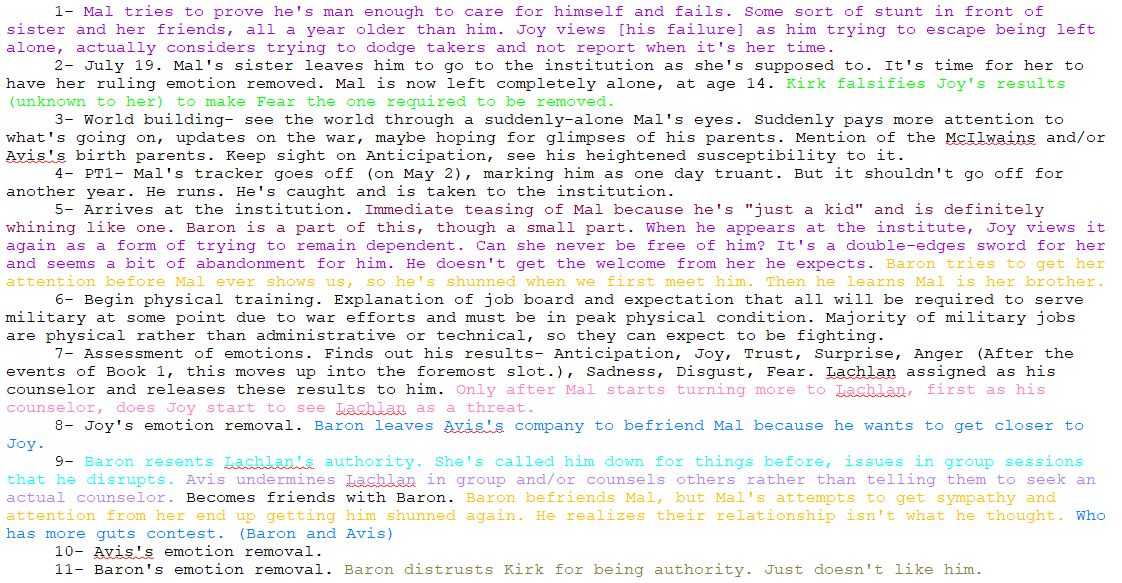
Yeah, this was planned to be the first book of a trilogy, and I was planning out the whole trilogy’s road map, hence the Book 2 reference. But anyway, this covered the basic plot. I did write out interpersonal conflicts between characters and expanded those a bit to make 3 to 7 conflict arc bullet points for those character conflicts. When assigning them to separate overall plot points, I color coded them for each character to make keeping track easier. So each of my 7 main points had a list of character points in them. I’d write them out with a number for that conflict’s order in its own arc.
​
Then it’s a matter of logically trying to combine plot points into chapters. Keeping it to one or two major moments in a chapter outline keeps me grounded and moving forward, while keeping me from trying to cram too many things into one scene or section. The first eleven chapters, which was about a third of the finished plan. So this takes us roughly through PT1 and partway into the P1 area of our whole arc. 
Picture

Below is the text from above, lacking the color coding.
1- Mal tries to prove he's man enough to care for himself and fails. Some sort of stunt in front of sister and her friends, all a year older than him. Joy views [his failure] as him trying to escape being left alone, actually considers trying to dodge takers and not report when it's her time.

2- July 19. Mal's sister leaves him to go to the institution as she's supposed to. It's time for her to have her ruling emotion removed. Mal is now left completely alone, at age 14. Kirk falsifies Joy's results (unknown to her) to make Fear the one required to be removed.

3- World building- see the world through a suddenly-alone Mal's eyes. Suddenly pays more attention to what's going on, updates on the war, maybe hoping for glimpses of his parents. Mention of the McIlwains and/or Avis's birth parents. Keep sight on Anticipation, see his heightened susceptibility to it.

4- PT1- Mal's tracker goes off (on May 2), marking him as one day truant. But it shouldn't go off for another year. He runs. He's caught and is taken to the institution.

5- Arrives at the institution. Immediate teasing of Mal because he's "just a kid" and is definitely whining like one. Baron is a part of this, though a small part. When he appears at the institute, Joy views it again as a form of trying to remain dependent. Can she never be free of him? It's a double-edges sword for her and seems a bit of abandonment for him. He doesn't get the welcome from her he expects. Baron tries to get her attention before Mal ever shows us, so he's shunned when we first meet him. Then he learns Mal is her brother.

6- Begin physical training. Explanation of job board and expectation that all will be required to serve military at some point due to war efforts and must be in peak physical condition. Majority of military jobs are physical rather than administrative or technical, so they can expect to be fighting.

7- Assessment of emotions. Finds out his results- Anticipation, Joy, Trust, Surprise, Anger (After the events of Book 1, this moves up into the foremost slot.), Sadness, Disgust, Fear. Lachlan assigned as his counselor and releases these results to him. Only after Mal starts turning more to Lachlan, first as his counselor, does Joy start to see Lachlan as a threat.

8- Joy's emotion removal. Baron leaves Avis's company to befriend Mal because he wants to get closer to Joy.

9- Baron resents Lachlan's authority. She's called him down for things before, issues in group sessions that he disrupts. Avis undermines Lachlan in group and/or counsels others rather than telling them to seek an actual counselor. Becomes friends with Baron. Baron befriends Mal, but Mal's attempts to get sympathy and attention from her end up getting him shunned again. He realizes their relationship isn't what he thought. Who has more guts contest. (Baron and Avis)

10- Avis's emotion removal.

11- Baron's emotion removal. Baron distrusts Kirk for being authority. Just doesn't like him.
Pay special attention to chapters 5 and 9. Those in particular have multiple colors (I hope I can maintain that in the online form - I did via a snapshot so yay!) showing where character bullet points overlapped. Those are points of greater tension, just by nature of having more colors in them, so it’s a bit easy to tell at a glance if something is going to be complicated or high emotion. Don’t want to make things too complex all the time, right?

For this particular project, that’s as far as I went in outlining. But in the years since I’ve worked on this, my outlines have gotten even more to a half-draft situation. Now, I’ll usually take those colorful charts (I call them sprinkle charts because they end up so vibrant they make me think of cake sprinkles) and expand a bit further for each chapter. If I come up with a snippet of conversation or description that might be important, I’ll include that as well. For example, the first chapter of a recently-back-burnered project looks like this at this final draft stage:

Crafting Final exam
In preparation for their enchantment assessment, which will pave the way for their pairings and the rest of their lives, each student must make an item to be used in those assessments. It need not be overly fancy or finely made. This is only a tiny part of the test. Function, sturdiness, etc is more important than appearance or decoration. These newly-made items will be gathered and become part of the final enchantment assessment.

No, you will not see the item you made in your assessment. Items will be drawn randomly, but yours will be removed if it happens to be drawn. Draws are done by the staff before the test, so it is 100% random. So no trying to prime something or pre-enchant it in hopes to give yourself an edge, or to sabotage someone specific. You’re more likely to help or harm someone unintended if you do such.

Whitt is a jeweler and makes some sort of pendant. No gems, simply cast and carved. As such, he’s the first one finished, as others are trying to be more showy, making earrings (having to make a pair) or bracelets or full necklaces, or just anything that’s more time consuming and labor-intensive. Whitt walks out seeing [FRIEND] making an elaborate hair net, but his work is all the gem captures with wire. The chain (the same chain he used to hang his pendant) is freely available to use.

This already is longer, for just being one chapter. It’s roughly as long as the whole first 5 chapters of the other example’s sprinkle chart. It’s got background situational details for me to reference, rules for the world so I’m set up well in context, and character information. I even use my [NOTE TO SELF] trick, where I don’t have a detail at the moment, so I just put in brackets in all caps what I need, so I can just move on and fill the blanks later. Brackets are easy to search for without getting extra results, since they’re rarely used in my fiction. In this case, I need a friend’s name. Until I can be bothered to name the friend, they are simply [FRIEND].

But what about chapter outlines later on, where I don’t need world setup details? Well, by then, we’re into the meat of the story. Those can get even longer! This is just a few chapters later in the same story.

6. The Pairing
Huge murmurs, uproar, etc. Friend is the one who blurts out so Whitt gets it. “Someone actually BOUGHT the top spot? That had to cost [Value]!”

That explains it. But no one knows who. Guard isn’t a noble surname. A bastard? Did someone seriously buy the spot for a BASTARD? Even prince Florent didn’t get his position advanced. He’s sitting around like 13 or 14 in a row.

Olivine stands up from her place in the crowd, looking a tiny bit sheepish, then seems to steel herself. In a clear voice, she states, “I choose Whithan Ramsey.”

Whitt’s stomach drops, but he stands. “Whithan Ramsey, Delver, Paired to Olivine Guard. Please proceed to the scribe. Second pairing selection. Borealis Gladthall.”

Whitt doesn’t manage to comprehend the sounds going on as Bori makes his choice (Nevi Miller). He makes his way to the scribe for the finalization, including the signing of their contract and the exchange of their gifts.

Olivine stares pointedly at the scribe, not at Whitt, and he wonders if he’s gotten someone who will see him as little more than a pet. When they are instructed to face one another and present each other with their gifts, Whitt realizes Olivine isn’t going to have any appreciation for the boyhood treasure he brought. Sure enough, she looks very confused, but says nothing. She presents him with [INDICATOR OF HER DESIRE FOR INDEPENDENCE] but he takes it as a sign that she sees him as property, or something similar. He’s a possession. A pet, at best. How much worse could it be?

Or this, which is from well later, in the P1 section of the outline.

22. Status Quo?
Meeting with Shepherd, called in because Wilde is returned (this needs to be quick. Did she come on the same train as Holloway?)

Holloway is also there for this. After they heard about how Whitt’s attempted poaching by Prince Clay, they insisted any formal action against Whitt, they be there to witness, so when Whitt and Olivine are called before Shepherd and Wilde, Holloway is there.

[PROF WILDE NEEDS TO BR BROUGHT IN SOON FOR CHASTISEMENT WHEN SHE RETURNS. SHE ACTUALLY ASSESSES LIV AND MAYBE REMEMBERS HER MOTHER, ALLOWS HER ACCESS TO THE STUDIO, BUT ONLY UNDER HER PERSONAL SUPERVISION.]

It’s in this whole bit that Holloway finds out that Whitt and Olivine figured out breaking objects intentionally, and they’re not the only ones. Nevi knows. Secrets don’t stay secret if more than one person knows about it. You, Whitt, HAD to know, as you’re directly part of the secret. But your crafter, and this… Nevi? Who else knows?

What about Holloway’s noble?

Once dismissed, Wilde actually tells Liv she’s eager to have her in studio. Another set of eyes, hands, and opinions are always welcome. This openness makes Whitt, Liv, AND Holloway uncomfortable.

Holloway tries to dismiss Liv, but Whitt needs to pull the same line Holloway did, something along the lines of “we’re in this together. Anything you say to me will reach her ears anyway. Save me a step.”

Holloway takes them to their office, which Whitt has never been to before. Needs to be stark, sterile, like no one ever goes there. No works in progress, no papers, notes, any of that. No reference books, art, plants, nothing. But Holloway at least looks marginally comfortable.

“I distinctly recall telling you not to inform anyone of the nature of our affinity.” Pause. “I’m assuming she knows everything.” Liv shoots back, “If I didn’t, I would certainly be asking now.”
Holloway blushes a bit at the foible, but recovers. “So how many other people have you been spreading this information to?”

Whitt says he figures his noble should be able to know his full abilities and limitations. It only makes sense. Doesn’t your noble know what you can and can’t do?

LEARN THE HORRIBLE FATE OF HOLLOWAY’S NOBLE. Incapacitated? Vegetable? Dead? What’s the deal here? Their noble has to be some sort of vegetable, being kept alive only by some specialized Tasked item that serves as life support. Also thinking maybe Holloway is in love with him/her/them?

So in short, Yes, Holloway’s noble knows, but only because they’ve told them while unconscious or incapacitated. Not like they can say or do anything about it. But I only told them after they could absolutely keep the secret.

Whitt - well, we’re not like that. We’re partners, even when we can both talk. You’re going to have to accept the fact that Olivine knows.
Holloway, clearly angry, dismisses them.
That could have gone better.

I map out ideas, brainstorming some. Ask myself questions that I’ll need to answer when I really write. I have bits of conversation to start off with, everything.

When outlines of chapters get to that size and level of detail, it becomes clearer why I call this stage Draft Point Five. An outline can easily get into the 10s of 1000s of words, which is comparable to a novella or children’s novel. Loads of info, and a very strong picture of the whole story overall.

But it’s doing this that helps me pinpoint places where I’ll get stuck or struggle. For me, that’s usually around the 70% part in a story, heading towards wrapping up. But rather than finding out that I’m stuck or need to rework something early on, after putting in dozens of hours and 50000 words, I’ve only put in maybe half a dozen hours and 12000 words. I can more easily rework things when I don’t have too much sunk into what turned out to be a problem. I can find and address issues with a purpose, rather than feeling overwhelmed with ALL THE CHANGES I’LL HAVE TO MAKE. I’ve set myself up for easier changes that won’t crush me later on.

This is so powerful for morale for me. It makes my first real drafts cleaner and easier. Once I do have a full working draft and sit down to write, each chapter is its own road map, with clear signs pointing me to the end goal.

That’s pretty much my outlining process all told. Early prep and problem-solving to save my sanity down the road. And I find I very much enjoy outlining now, as I get to discover more of the story up front and give myself things to look forward to, rather than it being a mystery with the lingering “Am I going to write myself into a corner?” dread that I so often ran into before I started outlining.
​
I hope this is helpful, even a little. Find what works for you!
0 Comments

Outlining Part 2 of 3

6/30/2025

0 Comments

 
In my last post, I discussed the 7-Point Plot Structure and how I use it to create the barest of outlines for my stories. It’s pretty simple to use, but it does leave a whole lot to be desired in the way I use it. I might only have a dozen sentences in my outline between all 7 points. Not a lot of flesh there. 

But that’s when we can really start using it to develop more than the basics.

7-Point Character Arcs
Probably one of my favorite supporting uses for the plot structure is in character arcs. I use this as a way to give my characters agency, keep track of their individual desires and actions, and to help flesh out my overall outline. I find it particularly useful when I have multiple prominent characters, but especially for the protagonist and antagonist. 

I don’t necessarily keep a Hook in place for all my characters, but I often have one, just as a sort of anchoring point for bringing them into the action. While I don’t actually have a set of character plot-outlines handy as examples, the idea is very simple. Each character has their initial outset and goal for whatever portion of the story they’re in. In simple ways, I try to create each character’s arc the way I do the main plot: Plot Turns 1 and 2 are inverses or foils for each other, as are Pinches 1 and 2. So a character might start out hating the protagonist when PT1 has them butt heads in a competition. But by PT2, the protagonist has done SOMETHING to turn the character’s opinion around, and now in PT2, they in turn do something to SAVE the protagonist. An about face, but one that will make sense as a foil for who they were at the beginning of the story.

What’s really great about doing this, is creating personal arc outlines for characters gives you as the author more information to place in your greater outline. With multiple character arcs going on across the length of the story, you can map out when in the outline these moments happen, where they overlap, and where they’ll be most effective in the story. This in turn is a great way to make conflicts more dramatic, if you have two characters’ Pinch 1 moments happening in the same chapter, scene, or general timing in your plot. 

Say we have Timmy and Nadine, a pair of school students. Nadine is our protagonist, with the plot revolving around her becoming star of the swim team.

Timmy, Nadine’s friend, has his own character arc involving family life and bullies.

Nadine’s Pinch 1 moment, where the stakes are raised, is all about her swimming rival appearing, a new student with eyes on the championship.

Sure, that’s bad, but we can make it worse by adding Timmy’s PT1 moment into the scene: Timmy reveals to Nadine that his parents are getting divorced, and he might have to move.
Now Nadine’s story is complicated by her friend’s plot point. 

What’s great is, these arcs don’t need to move at the same pace. Some character arcs might be shorter, with the whole 7-point structure playing out in microcosm within one of the main plot’s points. Timmy’s story might come to a crux and resolution before Nadine even gets to the midpoint of her story, or maybe Timmy’s story comes to a head with severe bullying during Nadine’s Plot Turn 2, and Timmy’s resolution (let’s say he kicks his bully’s ass) inspiring Nadine to take real action against her rival.

If you’re one of those people who likes complex storylines with lots of characters, this can be an invaluable practice. Giving basic outlines to all your main characters, then breaking them into their individual pieces and organizing them into timing can almost make a whole story for you. Figuring out when and where to put important plot points for a whole cast gives you lots to work with, and then you can even start merging plot points together to raise the stakes. Two characters’ Pinch 2 moments happen at the same time? Make it so their goals are counter to one another, and however the event plays out, one succeeds and one fails. That gives them the drive to compete with one another.

7-Point Series Outlines
In the same way you can shrink plot structures to suit character arcs, you can also blow them up to cover the main points of a whole series (or trilogy, or whatever). It was exactly this reason that The Deadly Studies was originally planned to be a 7-novella series. Necessity ended up making it a 10-novella series, as plot points did keep growing, but that happens. Initially, I had the overarcing plot of the whole series split into a basic 7-point structure. Each plot point was intended to be one novella. I don’t have the original outline I had, but it went something similar to this:

H - Luc loses his family, victim to an assassin plot
PT1 - Luc gets adopted by the Assassin’s Guild and trains, making friends
P1 - Luc and his friends grow apart for personal reasons. Their goals take them in contrasting directions. Luc has to leave Europe for the United States
MP - Luc makes a frenemy in Tom Statford, protagonist of the main series - this is where he is set up as the character he becomes in the main series
P2 - Unable to defend himself against the wrath of literal deities, Luc makes friends again, with Tom, despite hating him.
PT2 - Luc discovers the assassin who killed his family was his sister - She’s alive and an assassin too! But for his mortal enemies.
R - Luc ends his sister and takes his place against the Templars (this was always intended to be open ended, as it ties into its parent series, The Statford Chronicles by John G. Walker)

So even in the macro-plot of the series, I had points that mirrored one another. In PT1, Luc gained a new family. In PT2, his real family was taken away from him a second time, as he discovered his sister was not only alive, but was the one who assassinated the rest of their family.

Incomplete Outlines
Thing is, you don’t HAVE to hit every point on an outline. If you’re doing character arcs, you can interrupt an outline with a character dying. Any remaining points might get handed down to another character as part of dealing with the grief or aftermath of their death. Or it just leaves emptiness, a sense of incomplete possibility. 

As long as you’re flexible and using these points as tools, you can do a lot just staying within this structure. Is it perfect and infallible? Hell no. It’s a start, a tool to use. But I’ve found some good ways to use them.
0 Comments

Outlining - Part 1 of 3

6/23/2025

0 Comments

 
Time for another post on writing processes, and this is going to be going into my personal outlining process. Your mileage may vary; you might be better served as a pantser. You might be even more of a planner than I am. This is just one man’s method. It’s always being refined and adjusted for each project, but it at least serves as a starting point for me.

Personally, I’ve discovered that I save myself a lot of stress and failed projects if I put more effort into my outline than if I just write as I go. Pantsing, as it’s called, leads me to frustrating places I don’t necessarily want to go, and I have a hard time backtracking when it gets to that point. As a result, my outlines come in two stages. I’ll call these stages the Short Outline and Draft Point-Five.
​
For blog purposes, I’ll be breaking this into three posts. So here’s Part 1!

The Short Outline
This is the stage all my projects start in. My general structure (as of right now) tends to be the 7-Point Structure. That is:

The Hook: a compelling introduction to the story’s intriguing world and/or characters.
Plot Turn 1: an inciting incident that brings the protagonist into an adventure.
Pinch 1: the stakes are raised with the introduction of the antagonist or the major conflict or challenge
Midpoint: a turning point in the story where the protagonist goes from reaction to action.
Pinch 2: the major conflict takes a turn for the worse, and all appears lost for the protagonist.
Plot Turn 2: the protagonist discovers something that helps them resolve the major conflict or defeat the antagonist.
Resolution: the major conflict is resolved, and the antagonist is defeated.

Needless to say, the way these develop for me is usually with the Hook, or the initial plot idea I had. What makes the story start in the first place. The situation. I might already have the first Plot Turn (PT1) in my head, as well. Generally, I’ll have the most basic version of the conflict in mind. That’s at least the basic starting point of most of my stories. For illustrative purposes, we’re going to be looking at my short outline for the first book of The Deadly Studies series of novellas, Assassin’s Victim.

For this, I started with an initial idea for a first line, and a snippet of what the character was at the beginning. I also had a specific date in mind, as this was a time-sensitive plot point. 

H- [8/1/92] was the day I stopped believing in God, but I don't remember exactly why. Young lacrosse player.

Wasn’t much, but it was the hook. I also had PT1 all set, and it looked like this:


PT1- Luc is approached with a proposition- thinks its regarding his father's business, but it's actually regarding him. Templar attempt at shady recruiting. He offers to fund Luc's way onto a youth traveling lacrosse team?

It sets up the initial conflict: a stranger disturbs the normal routine with a proposition. There’s a lot to it, but it involves the eventual antagonists of the series as well as the smaller conflict of this first book itself. From there, I usually use a sort of mirroring/antithesis approach. I like using logic to make PT2, the turning point for victory, be a symbolic inverse of PT1, where the world gets upended. So rather than try to fill the next structure point, I go to PT2 and figure out how the main conflict will turn around for our protagonist. In this case:

PT2- If I become it, I can fight it. Accepts proposition/mentorship with Auguste Fosse.

So while PT1 here has Luc given a proposition (which I know he will reject), PT2 has him realizing that the greatest advantage he can get is to seize his opportunity to train and become a weapon. Only he wants to be a weapon AGAINST what he was approached by before. 
From here, it’s mostly filling in the blanks. I’ve gotten the two basic turning points of the plot. I approach the Pinches (P1 and P2) the same way, with trying to make them inverse or opposite style situations. P1, for me, often becomes the sort of last straw in taking action. The protagonist has no choice now but to go on their new path. In the case of Assassin’s Victim, P1 had to be Luc losing everything, and it had to be to the very monsters he rejected. A direct reaction to his refusal of the proposition in PT1. So…

P1- Assassination- family dies

And then to counterbalance that, in P2, he needs to regain a family. The same people who killed his family want to finish the job. But he’s not alone.

P2- Templars come searching for him. Wanting to recruit him to their cause, openly this time. When he refuses, thinking them to be the ones who murdered his family, they attempt to take his life. He's saved by a shadowy figure- Auguste Fosse.

It’s there that he gains a new father figure and the new direction to resolve the conflict altogether. In this case, becoming an assassin like he was victim of.

The last pieces of the puzzle are the final Resolution and the MidPoint (MP). MP is easy, as it’s a literal turning point. What causes the protagonist to turn from reactive to proactive. It could be an external force, but in this case, I chose to have it be a conscious decision.

MP- Ends his grief, begins his search/vendetta.

Luc resolves to change things. It’s as simple as that. And finally, the resolution. A lot of that was covered in PT1, but the final should, once again, somewhat mirror the inciting incident, resolving the conflict itself.

Simply put, R- Luc is going to become an assassin. 

So as a whole, here’s how my Short Outline for Assassin’s Victim looks:

H- [8/1/92] was the day I stopped believing in God, but I don't remember exactly why. Young lacrosse player.
PT1- Luc is approached with a proposition- thinks its regarding his father's business, but it's actually regarding him. Templar attempt at shady recruiting. He offers to fund Luc's way onto a youth traveling lacrosse team?
P1- Assassination- family dies
MP- Ends his grief, begins his search/vendetta.
P2- Templars come searching for him. Wanting to recruit him to their cause, openly this time. When he refuses, thinking them to be the ones who murdered his family, they attempt to take his life. He's saved by a shadowy figure- Auguste Fosse.
PT2- If I become it, I can fight it. Accepts proposition/mentorship with Auguste Fosse. 
R- Luc is going to become an assassin.

So… what?
Well, that’s it. That’s the basics. It’s a basic roadmap of the story, waiting to be filled with more detail. You can just go straight to writing from this. Personally, I don’t. I move on to my second part of outlining, which I call Draft Point Five, but I’ll go into that in another post in this series.
I also use the 7-point plot structure to expand outlines for larger projects, which will be in the next post of this series. 
0 Comments

Where Do I Go From Here?

6/9/2025

0 Comments

 
 I'm honestly very pleased that I've been maintaining weekly posts here on the website blog and an additional one each week on Patreon, since I started back in February. It's actually become something I look forward to on Mondays. I've been working on trying to get things prepped ahead of time. You know, actually thinking ahead, and that's going to become even more important in the coming months, as I might have a new job on the horizon that will eat up a lot of hours. Might mean Fridays or Sundays become my "get this set up and scheduled" date with Monday being the release date for posts. The last thing I want to do is to lose this momentum. I've been enjoying getting this done.

That said, planning blog posts ahead of time is not always easy. I don't always have something to write about, and while I do have some future posts in the works, I don't have a lot of them to fall back on if I'm having a dry spell.

So I'm getting help! I found this "A Year's Worth of Blog Post Ideas for Writers" post (you know, pretty much exactly what I was looking for) that is going to give me plenty of things to go on about for a while. I can pick at these ahead of time and have them ready in a pinch. Be prepared to see some of these coming in the future. Will they be in the offered order? I doubt it. Will it be one of these every week? Of course not. I have my monthly updates that I like to and will continue to post.

But these are going to be some direction, which I am grateful for. See you guys next week!
0 Comments

    Author

    A. F. Grappin is a general creative who mainly focuses on speculative fiction and crafting.

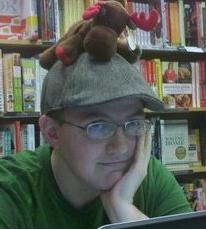
    ​That's me down there.

    Picture

    Archives

    February 2026
    January 2026
    December 2025
    November 2025
    October 2025
    September 2025
    August 2025
    July 2025
    June 2025
    May 2025
    April 2025
    March 2025
    February 2025
    September 2019
    September 2018
    May 2018
    March 2018
    October 2017
    August 2017
    April 2017
    November 2016
    August 2016
    October 2015
    May 2015
    March 2015
    August 2014
    May 2014
    April 2014
    March 2014
    February 2014

    Categories

    All
    Assassin
    Audiobook
    Autograph
    Balticon
    Blog Post
    Book Release
    Book Review
    Convention
    Cover Reveal
    Creativity
    Criminal From Birth
    Faire
    Festival
    Fiction
    Improvement
    Inspiration
    Literature
    Luc Bertrand
    Monthly Update
    Novel
    Opinion
    Outlining
    Plans
    Progress Report
    Projects
    Public Appearance
    Quest
    Reading
    Reading List
    Real Life
    Renaissance
    Renaissance Festival
    Roleplaying
    Roll Your Desting
    Short Story
    Speculative Fiction
    Starsigns
    Status Report
    Tennessee Renaissance Festival
    The Statford Chronicles
    To-read
    Updates
    Vampire Needed
    Writing
    Writing Technique

    RSS Feed

Site powered by Weebly. Managed by Bluehost